My product setup with AI

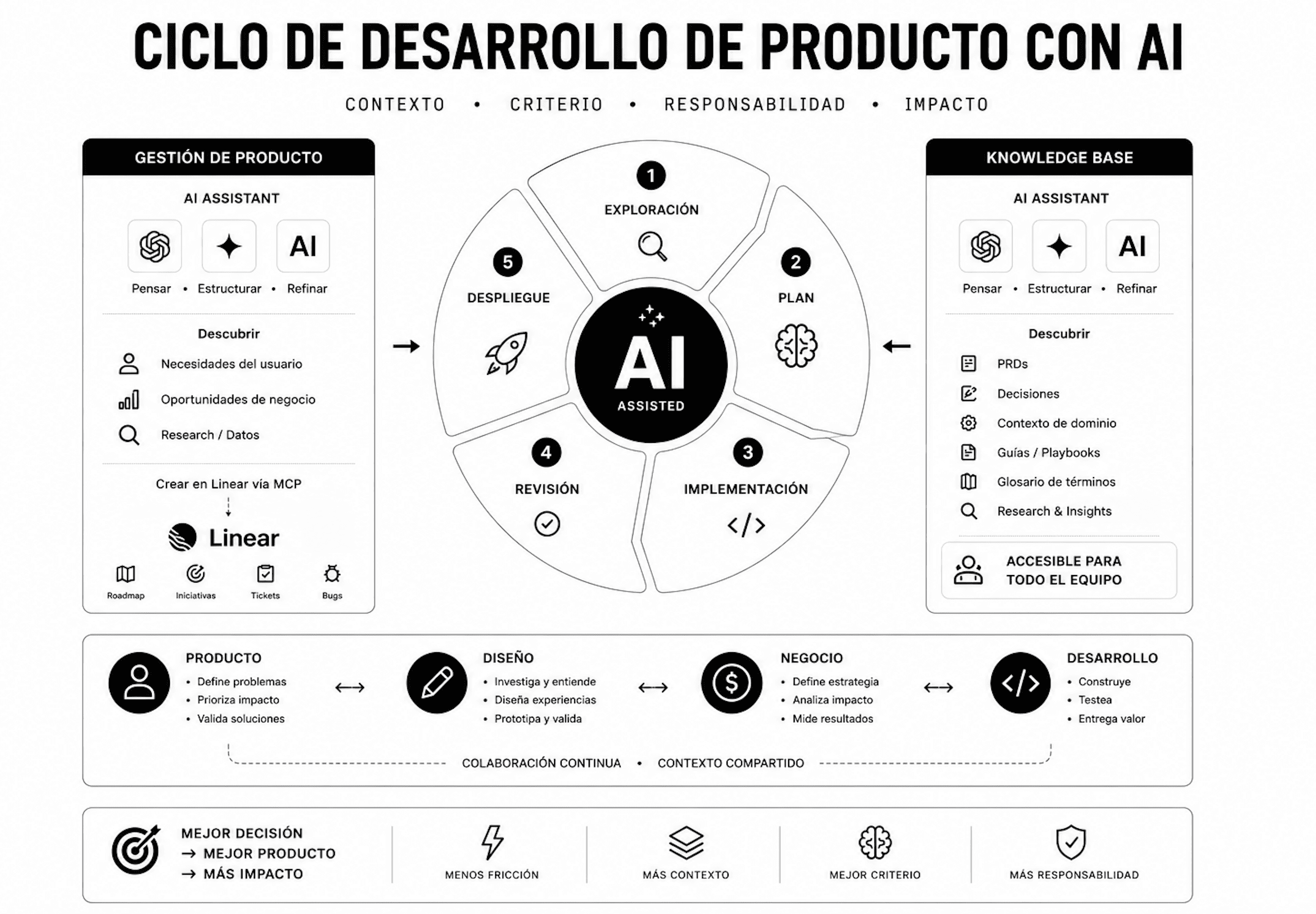
I've been thinking for a while about how to adapt the product development cycle to this whole whirlwind AI is bringing us. Not just from the code side, but looking at how product, design, business and development fit into an increasingly assisted flow.
I see it more and more clearly: the difference isn't only in generating code faster, but in connecting context better, applying better judgement and taking responsibility.
As of today this is my setup:
▪️ Product management Linear to manage roadmap, tasks and bugs.
Product no longer writes tickets by hand. They use their AI assistant of choice (whether ChatGPT, Claude, Gemini, etc) to think through proposals, structure problems, generate tickets, refine acceptance criteria or spot edge cases. Same for the devs, they consume these tickets from Claude Code.
▪️ Knowledge base Notion as a shared knowledge base.
That's where PRDs, decisions, glossaries of terms, domain context, functional documentation, research, business learnings and everything that helps product, design and technology speak the same language live (Domain Driven Design).
Same again, the "thinking" process can perfectly well be done using NotionAI or connecting ChatGPT (or whichever) via MCP to then "persist" the result in the specific page.
Non-technical people have to be able to feed the context without friction. That's why, for now, I'm avoiding git-based solutions. Having a web editor still seems key to me today.
▪️ Development Once we get into development, I split it into several stages:
🔸 Exploration: understanding the problem and gathering context (Linear, Notion, ADRs, etc)
🔸 Plan: We define architecture, make technical decisions based on the product's needs and bring it down to OpenSpec to turn requirements into a clear technical specification before implementing.
🔸 Implementation: Specialised agents with their tools, skills, testing, code conventions.
🔸 Review: Not just reviewing code. Reviewing decisions, trade-offs, risks and technical debt.
🔸 Deployment: validate, observe and review errors.
▪️ Production feedback Sentry to capture errors. A good logging system to be able to investigate incidents and give tickets more context.
The idea is that the assistant can help understand what happened, cross-reference context and propose hypotheses that feed the Linear tickets.
---
Obviously, this whole setup depends a lot on the context of each product. Tools, permissions, models and flows have to be adapted to the confidentiality, security and compliance requirements of each case.
Decision-making, risk management, maintainability and scalability are still the engineer's responsibility.
Now more than ever, a product and business mindset is going to make the difference.
I'd love to know how you're setting it up. What tools or practices are working for you to connect product, design, business and development with AI?
- ProductDevelopment
- AI
- Workflow
- Linear
- Notion
- MCP
- OpenSpec
- Sentry
- ClaudeCode
- DomainDrivenDesign
- ADR
- SoftwareDevelopment
- ProductManagement